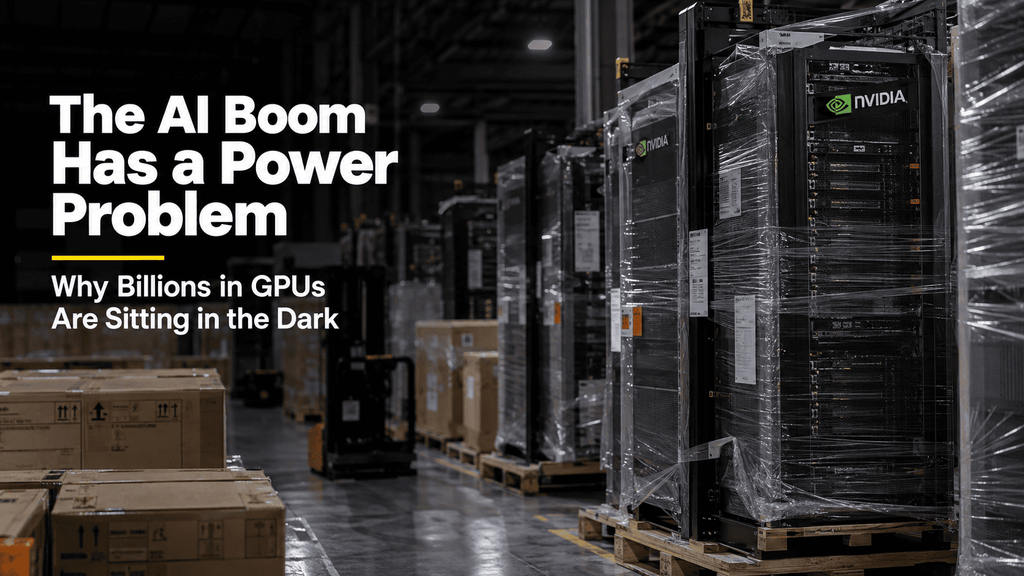
The race to build artificial intelligence is moving faster than the infrastructure needed to power it. And some of the world’s most advanced AI chips are reportedly sitting unused, waiting for electricity.
For years, the biggest obstacle to developing advanced artificial intelligence was obtaining enough computing power. NVIDIA GPUs became some of the most sought-after hardware in the world, with technology companies spending billions to secure them.
But the industry is beginning to encounter a different problem.
Companies can acquire the chips. They can build the servers. They can even construct the data centers.
What they cannot always do is turn everything on.
This emerging problem, known as dark GPUs, reveals a growing mismatch between the speed of semiconductor development and the much slower process of expanding electrical infrastructure.
And it raises an important question: What happens when the AI industry builds computing capacity faster than the world can power it?
Amazon’s Multibillion-Dollar GPU Problem
In October 2026, Business Insider reported that Amazon Web Services (AWS) was acquiring substantial quantities of NVIDIA’s latest AI systems before some of its facilities had the electrical capacity to operate them.
According to internal communications reviewed by Business Insider, Amazon expected to receive approximately $5 billion worth of NVIDIA GB300 server racks, followed by roughly $3 billion in additional systems each month.
The equipment was being secured through an arrangement called Early Rack Receipt, allowing Amazon to take ownership of completed server systems before they reached their final data centers.
However, some AWS facilities reportedly lacked sufficient power to operate the incoming hardware.
As a result, certain systems were being stored in intermediate warehouses rather than immediately deployed.
Amazon has defended the practice, explaining that staging hardware near deployment sites is a normal part of preparing new infrastructure.
There is a legitimate reason for purchasing hardware early: advanced AI systems are expensive, complex, and subject to supply constraints.
But purchasing equipment and putting it into productive operation are two very different milestones.
A GPU cannot generate computing revenue while sitting in a warehouse.
And the longer it remains there, the more expensive that delay becomes.
What Exactly Are Dark GPUs?
The term dark GPU generally refers to a graphics processing unit or AI accelerator that has been purchased but is not delivering its intended computing capacity.
This can happen for several reasons:
- Insufficient electrical power.
- Unfinished data center construction.
- Delays in cooling infrastructure.
- Networking or system integration problems.
- Hardware deployment delays.
- Poor utilization after installation.
The distinction between these problems matters.
A GPU that cannot be powered on is fundamentally different from one that is operating at only 30% utilization.
The first is an infrastructure problem. The second may be a scheduling, software, or demand problem.
Both represent unused computing potential, but they require different solutions.
In the current AI infrastructure expansion, access to reliable electricity has become one of the most significant concerns.
Why Can’t Companies Simply Plug In Their GPUs?
An AI server is not comparable to an ordinary desktop computer.
Modern AI accelerators operate at extraordinary power densities, and deploying them at scale requires an entire supporting infrastructure.
Consider NVIDIA’s GB300 NVL72 system.
According to NVIDIA’s technical documentation, a GB300 NVL72 rack has a designed power budget of approximately 135 kilowatts.
That is the electrical power budget for a single rack.
Now imagine a data center deploying 100 of these racks.
The theoretical rack power requirement becomes:
100 × 135 kW = 13,500 kW
That’s 13.5 megawatts, before accounting for additional facility requirements such as cooling, electrical conversion losses, and supporting infrastructure.
And this is only 100 racks.
Large AI installations may require hundreds or thousands of racks, depending on their design.
Power at this scale cannot simply be obtained by connecting another cable.
It may require new substations, transformers, high-capacity transmission connections, distribution equipment, backup systems, and major cooling installations.
All these systems must be engineered, manufactured, installed, tested, and commissioned.
While semiconductor manufacturing progresses through rapid technology cycles, electrical infrastructure often operates on much longer development timelines.
A new generation of AI processors can arrive before a data center’s electrical infrastructure is ready for the previous generation.
That mismatch is becoming increasingly important.
The Real Bottleneck Is More Than Electricity Generation
When people hear that AI data centers lack power, they often assume the world is simply not producing enough electricity.
The problem is more complicated.
Electricity may be available at a national or regional level while remaining inaccessible to a particular data center.
A facility might need 200 MW of dependable power, but the local grid connection may support only a fraction of that requirement.
Increasing capacity could require upgrades across several layers of the electrical network.
The challenges include securing power generation, obtaining utility agreements, expanding transmission and distribution infrastructure, manufacturing transformers and switchgear, and ensuring reliable operation under changing AI workloads.
Even when sufficient electricity exists somewhere on the grid, delivering it to the correct location at the required capacity can be difficult.
This creates an unusual situation.
A technology company might have billions of dollars in computing equipment ready for deployment, yet remain dependent on electrical infrastructure that cannot be expanded at the same speed.
The bottleneck is no longer exclusively about manufacturing faster processors.
It is increasingly about delivering enough usable power to operate them.
The Numbers Behind AI’s Growing Energy Demand
The scale of this challenge becomes clearer when examining global electricity consumption.
According to the International Energy Agency’s 2026 report Key Questions on Energy and AI, data centers consumed approximately 485 terawatt-hours of electricity in 2025.
The agency projects that consumption could reach approximately 950 terawatt-hours by 2030.
That’s nearly twice as much electricity in just five years.
AI-focused facilities are expected to grow even faster, with their electricity consumption projected to triple over that period.
However, the IEA also highlights an important distinction: improvements in hardware and software efficiency are reducing the energy required for individual AI tasks.
The problem is that AI adoption and the complexity of workloads are growing rapidly.
More organizations are deploying large models, running increasingly sophisticated reasoning systems, and integrating AI into applications that operate continuously.
Efficiency improvements can reduce the cost of individual tasks without necessarily reducing the industry’s total electricity demand.
Microsoft Has Encountered a Similar Challenge
Amazon is not the only company confronting this issue.
In a November 2025 discussion, Microsoft CEO Satya Nadella explained that the company’s challenge was not simply obtaining more chips.
It was obtaining enough completed data center capacity to install and operate them.
Nadella described having hardware in inventory that could not yet be connected to ready-to-use facilities.
His comments highlighted a fundamental change in the AI infrastructure race.
For years, the limiting factor was access to advanced semiconductors.
Now the industry must coordinate semiconductor supply with construction, electrical engineering, cooling technology, and energy availability.
Owning an accelerator is not equivalent to having usable AI computing capacity.
Why Idle GPUs Are a Financial Problem
The economics of AI infrastructure make deployment delays especially significant.
Advanced accelerators require substantial upfront investment.
Companies spend money purchasing hardware, constructing facilities, and preparing the systems required to operate it.
Once running, those systems can generate revenue by providing computing services, training AI models, or powering commercial applications.
But before deployment, that hardware represents capital tied up in equipment that has not yet begun producing its expected returns.
There is also a technological risk.
AI hardware is improving rapidly.
A system purchased today may face competition from newer and more efficient hardware before it has delivered its expected economic value.
This does not automatically mean that purchasing equipment early is a mistake.
Securing scarce accelerators can be strategically valuable, especially if companies expect future demand to exceed supply.
The critical variable is how long the equipment remains unused.
A short deployment delay may be a manageable part of infrastructure development.
A prolonged delay can significantly affect project economics.
Could Dark GPUs Signal an AI Bubble?
The existence of unused hardware raises questions about whether the AI industry is investing too aggressively.
However, dark GPUs alone do not prove that an AI bubble exists.
There are at least two possible interpretations.
The first is that demand is growing faster than infrastructure can support.
In this scenario, companies purchase GPUs early because they expect demand to remain strong. The hardware may eventually become highly productive once electrical and cooling infrastructure catches up.
The second is that infrastructure investment is moving ahead of commercially sustainable demand.
In this scenario, companies may be committing enormous amounts of capital before knowing whether their future AI services can generate sufficient returns.
Both possibilities deserve attention.
The most important evidence will not necessarily be the number of GPUs purchased or shipped.
It will be how quickly those GPUs become operational, how heavily they are utilized, and how much economic value they produce.
The Next AI Breakthrough Might Come From Infrastructure
Much of the public conversation about artificial intelligence focuses on models, algorithms, and semiconductor performance.
But this infrastructure challenge suggests that future progress may increasingly depend on innovations outside conventional AI research.
More efficient cooling systems could allow data centers to support higher computing densities.
Improved power distribution and energy storage could help facilities accommodate rapidly changing workloads.
Better scheduling and workload management could increase the amount of useful computing delivered by existing hardware.
More energy-efficient accelerators and AI architectures could reduce the electricity required for each computation.
And closer coordination between technology companies, utilities, and infrastructure developers could reduce the time between purchasing a server and putting it into operation.
These changes are less visible than the release of a new AI model.
Yet they could have enormous consequences for how quickly artificial intelligence becomes available and affordable.
The Real Race Is No Longer Just About GPUs
The AI industry has spent years competing to acquire the fastest processors.
That competition is not disappearing.
But advanced computing hardware is only one component of a much larger system.
A GPU requires electricity, cooling, networking, supporting infrastructure, and software before it can perform useful work.
Without those components, even the most advanced accelerator remains an expensive piece of hardware.
The emerging dark GPU problem illustrates an important reality about technological progress: innovation at one layer does not guarantee that the rest of the system can keep up.
The companies that succeed in the next phase of the AI boom may not simply be those that purchase the most computing hardware.
They may be the ones that can turn that hardware into reliable, efficiently operated, economically productive computing capacity.
Because in the end, the most valuable GPU isn’t necessarily the fastest one. It’s the one that can actually be put to work.
Sources and Further Reading
- Eugene Kim, Business Insider — Amazon is buying billions in Nvidia AI systems it can’t yet turn on (October 20, 2026).
- International Energy Agency — Key Questions on Energy and AI (2026).
- NVIDIA — Mission Control Software Administration Guide, GB200/GB300 NVL72 power budgeting.
- Data Center Dynamics — Microsoft has AI GPUs sitting in inventory because it lacks the power necessary to install them (November 3, 2025).